
Alternatives to Using Towels for Hot Dishes
Table of Contents
- Why a Kitchen Towel Fails at Hot Dishes
- Microwaveable Bowl Cozy Benefits for Daily Meals
- How to Safely Remove Hot Bowls from the Microwave
- Cotton Bowl Cozy vs Kitchen Towel: A Direct Comparison
- Task-by-Task Picks: Which Tool for Which Hot Job
- Handling Hot Dishes Without Any Towel at All
- Conclusion: Build a Safer Hot-Dish Routine
- Frequently Asked Questions
Last Updated: October 14, 2026
Why a Kitchen Towel Fails at Hot Dishes
A standard kitchen towel is not a heat-resistant tool, and treating it like one is how burns happen. Cool Hand Nukes makes bowl cozies for exactly this problem, but the problem is bigger than any single product. Most people reach for the nearest dish towel because it is already hanging there.
Alternatives to using towels for hot dishes fall into a few clear categories: purpose-made fabric cozies (like those found at https://CoolHandNukes.com/products/100-cotton-microwavable-bowl-cozy-souperbowl), heat-rated mitts and potholders, silicone grips, and simple technique changes. Each one solves a different part of the problem.

The Wet-Cloth and Steam-Burn Problem
A damp cloth is worse than a dry one for hot dishes. Water conducts heat far better than air does, so once a towel is wet, heat travels straight through it to your hand.
Steam adds a second hazard. The Canadian Centre for Occupational Health and Safety guidance on thermal burns notes that steam burns can be more severe than dry-heat contact because the vapor releases additional energy as it condenses on skin.
Heat Ratings: What Fabric Can Actually Take
Heat resistance is measured, not guessed. Most everyday fabrics have no heat rating at all, which is the core issue with grabbing a random towel.
- Cotton and linen: comfortable for brief contact with warm items, not rated for sustained heat
- Terry cloth: thick and absorbent, but the loft traps moisture and steam
- Microfiber: good for drying, poor for heat because it is thin and synthetic
- Heat-rated mitts and potholders: tested to a stated temperature, usually printed on the label
- Silicone grips: rated for high heat and easy to rinse, but they do not absorb anything
The practical takeaway is simple. If a fabric has no heat rating printed on it, do not trust it with a bowl straight out of the microwave.
Microwaveable Bowl Cozy Benefits for Daily Meals
A microwaveable bowl cozy (available at https://CoolHandNukes.com/products/classic-bowl-cozy-youre-a-wizard-harry) is a fabric sleeve that holds a bowl so your hands never touch hot ceramic.

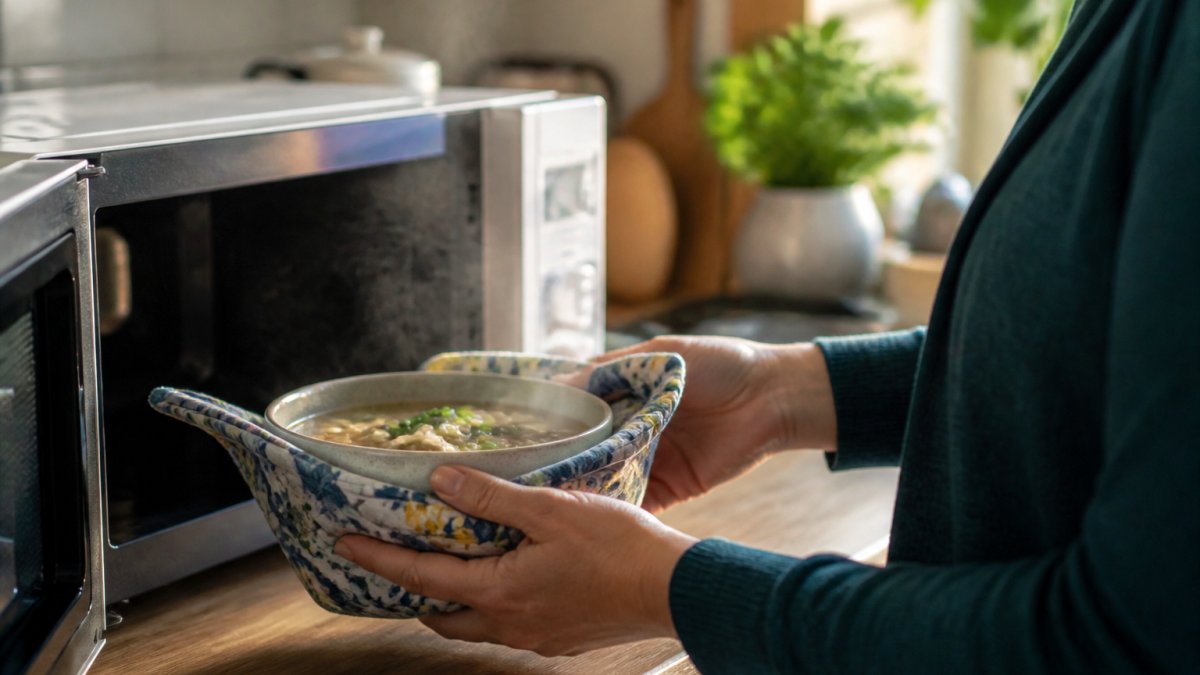
The design matters more than people expect. Cool Hand Nukes cozies are handmade in Nova Scotia from 100% cotton with specialized insulation, and they fit standard bowls with a 4 to 8 inch diameter.
Three benefits show up again and again in daily use:
- Heat protection: the cotton and insulation layer keep the bowl's heat away from your palms
- Surface protection: setting a hot bowl down on a counter or table leaves no heat marks
- Comfort: you can carry a bowl from the microwave to the couch without juggling
Grip, Stability, and Hand Tremors
Grip is where a cozy quietly outperforms a towel. A towel requires you to bunch it, hold tension, and balance the bowl on top of folded fabric. A cozy wraps the bowl itself, so your hands close around a stable shape.
For anyone with reduced grip strength, hand tremors, or neuropathy, that stability is the whole point. A bowl that sits inside a fitted sleeve is far less likely to tip than one balanced on a wadded cloth.
How to Safely Remove Hot Bowls from the Microwave
Safe removal comes down to three things: a stable grip, a dry barrier, and a clear path. Get those right and the process stops being risky.
Here is the sequence we recommend for removing a hot bowl:
- Let the microwave finish and wait a few seconds for steam to settle
- Slide your hands into the cozy's sides, not under the bowl
- Lift straight up, keeping the bowl level
- Set it down on a heat-safe surface, not directly on a bare counter
- Keep your face back and slightly to the side when you uncover the bowl
That last step matters more than most people think. Steam trapped under a lid or cover releases in a burst the moment you lift it.
Cotton Bowl Cozy vs Kitchen Towel: A Direct Comparison
A cotton bowl cozy (find them at https://CoolHandNukes.com/collections/classic-bowl-cozy-4-8) beats a kitchen towel for hot dishes on every measure that matters: grip, heat protection, and mess. The towel only wins on one thing, and it is availability.
Here is how the two compare directly:
| Factor | Cotton Bowl Cozy | Kitchen Towel |
|---|---|---|
| Grip | Fitted around the bowl | Bunched, unstable |
| Heat protection | Insulated cotton layer | Thin, fails when damp |
| Steam risk | Low, hands stay clear | High near the bowl rim |
| Surface protection | Doubles as a trivet | None |
| Reusable | Yes, machine washable | Yes, but stains and thins |
| Best for | Microwaved bowls and soup | Drying and general cleanup |
The comparison is not really close. A towel is a drying cloth pressed into a job it was never designed for. A cozy is built for one task and does it well.
Where the towel still earns its place is cleanup, not heat handling. Use it to wipe the counter after the meal, not to carry the bowl to the table.
100% Cotton Microwavable Bowl Cozy - SouperBowl →
Task-by-Task Picks: Which Tool for Which Hot Job
Different hot jobs call for different tools, and matching them is what keeps hands safe.
The pattern is easier to see once you separate two things: how the heat arrives, and how you have to hold it. Round, bowl-shaped items that come out of the microwave are hot all over and need a wrap.
Here is how that plays out task by task:
- Microwaved soup, ramen, or oatmeal: a fabric bowl cozy. The bowl is round and hot on every side, so a fitted sleeve keeps your palms off the ceramic and gives you a stable shape to carry. This is the job a cozy was designed for.
- A hot baking sheet or roasting pan: heat-rated oven mitts. The pan is flat, heavy, and often wider than your hand, so you need a grip rated for oven temperatures and a dry barrier between the metal and your skin.
- A casserole dish or lasagna pan: mitts plus a trivet. These dishes hold heat for a long time after they leave the oven, so the resting surface matters as much as the grip.
- A mug of coffee or tea: a cozy or a silicone sleeve. The handle alone can get hot, and a sleeve keeps your fingers off the cup wall without changing how you drink.
- A plate from the microwave: a potholder or a second plate underneath. A plate is wide and thin, so it cools quickly at the edges but stays hot in the center; a towel gives you no margin if you grab the wrong spot.
- Lifting a lid off a hot pot: a dry, rated mitt, and keep your face back and to the side. Steam releases upward in a burst the moment the seal breaks.
- Moving a hot pot to the sink: two dry, rated mitts, one on each handle, and a clear path. A single towel bunched around one handle leaves the other side unguarded.
Two hazards cut across every task on that list:
Wet cloth. A damp towel is worse than a dry one for hot dishes. Water conducts heat far better than air does, so once a cloth is wet, heat travels straight through it to your hand. A towel that was fine for a warm plate becomes a heat conductor the moment it picks up moisture from the counter.
Steam. When you lift a lid or uncover a bowl, trapped steam escapes upward and can scald the hand holding the cloth.
The pattern here is that round, bowl-shaped, microwave-hot items suit a cozy, while flat and oven-hot items suit a mitt. Once you see that split, choosing the right tool takes a second, and the wrong tool stops being an option.
Handling Hot Dishes Without Any Towel at All
You can move a hot dish with no cloth at all if you use the right technique or the right tool. Sometimes the best alternative is not another fabric.
- Slide, don't lift: push a hot bowl along the counter with a spatula instead of picking it up
- Use two spatulas: cradle the bowl between them for a short transfer
- Let it rest: give the bowl a minute on the counter before you move it
- Use a cooling rack or baking sheet: set the hot bowl down and carry the whole tray
- Silicone grips: for flat items, a pair of silicone tongs or grips works well
These methods are slower, and that is the point. Speed is what causes burns. A few extra seconds of sliding beats a hand wrapped in ice.
It also helps to think about where the heat is going. A hot bowl set on a bare counter can leave a permanent mark.
Conclusion: Build a Safer Hot-Dish Routine
The real fix is not one tool. It is a routine where a hot bowl never touches a bare hand or a bare counter.
Set up your kitchen so the right tool is always within reach: a cozy for bowls, mitts for oven dishes, and a trivet or rack for resting. That way you never reach for a towel out of habit.
Most burns from hot dishes happen in the two seconds between the microwave door opening and the bowl hitting the counter. A fabric cozy removes those two seconds from the equation entirely.
Frequently Asked Questions
Is it safe to use a kitchen towel to hold a hot bowl?
A dry, thick towel can work for a few seconds, but it is not reliable protection. Heat passes through thin fabric quickly, and a damp or wet cloth conducts heat straight to your skin, which is how steam burns happen. Folded cotton gives some insulation, yet nothing holds it in place, so the bowl can shift. For bowls straight out of the microwave, a fitted cotton bowl cozy made for the job gives steadier, more predictable protection than a towel you have to bunch up.
What is the best way to move a hot bowl from the microwave?
Slide a cotton bowl cozy around the bowl while it is still on the turntable, grip both sides with two hands, and lift straight up. Set it on a cooling rack or baking sheet rather than directly on the counter.
Why are fabric bowl cozies better than towels for hot dishes?
A bowl cozy stays wrapped around the bowl instead of slipping, so your grip does not depend on how well you can bunch fabric in one hand. That matters for anyone with reduced grip strength or hand tremors. The insulation is also consistent: the same layer of cotton and batting sits between your palm and the ceramic every time, while a towel's protection changes with every fold. Cozies are machine washable and fit standard bowls with a 4 to 8 inch diameter.
Can I use a silicone mat instead of a towel for hot dishes?
A silicone mat or trivet protects your counter from heat marks, but it does nothing for your hands. Use it as the landing spot, not the carrying tool. The safer setup is a two-part routine: a bowl cozy or oven mitts to move the dish, and a silicone mat, cooling rack, or baking sheet to set it down. That combination covers both burn risks, the one to your skin and the one to your surfaces.
What are the fire safety risks of using towels to handle hot cookware?
Dry cotton towels left near a stovetop burner or draped over a hot pan can char and ignite. The bigger everyday risk is a towel touching a hot element while you are distracted. Keep towels away from active burners, never leave them on hot cookware, and use purpose-made heat protection like oven mitts or pot holders for stovetop work. For microwave bowls, a cotton bowl cozy keeps fabric away from the heat source entirely.