
7 Ways to Make Kitchen Tasks Easier With Arthritis
Last Updated: November 2, 2026
Quick Summary
7 ways to make kitchen tasks easier with arthritis include choosing tools with wide, lightweight grips, using a jar opener for use, and sliding or two-handed moves for heavy pots. Other steps are protecting hands from hot bowls, keeping everyday items within easy reach, pacing your cooking with rest breaks, and simplifying prep with shortcuts. You don't need to change everything at once.
- Choose tools with larger-diameter handles to spread pressure across your palm instead of your fingers.
- A 2016 PeerJ study found adaptive utensils with larger handles can reduce challenges for people with arthritis.
- Match your jar opener to the joint that hurts: wall-mounted for fingers, tabletop clamp for wrists.
- Slide heavy pots along the counter with a towel, and hold them with both hands when lifting.
- Store everyday items between waist and shoulder height to limit repeated overhead reaching and bending.
Table of Contents
- 1. Choose Tools That Reduce Grip Strength Demands
- 2. Use a Jar Opener Instead of Twisting by Hand
- 3. Lighten the Load When Lifting and Carrying Pots
- 4. Protect Your Hands From Heat With Bowl Cozies
- 5. Put Frequently Used Items Within Easy Reach
- 6. Pace Your Cooking and Sit When You Can
- 7. Simplify Prep With Cut-Free and Low-Effort Methods
- Start With One Change This Week
- Frequently Asked Questions
Arthritis can turn ordinary cooking into a daily struggle. Jars won't open, heavy pots feel impossible to lift, and a bowl of hot soup can be painful to hold. The good news is that a few small changes to your kitchen routine can make a real difference. Here at Cool Hand Nukes, we have put together seven practical ways to make kitchen tasks easier with arthritis, starting with the tools you reach for first.
1. Choose Tools That Reduce Grip Strength Demands
Tools with thick, wide handles are easier to hold when grip strength is reduced. Look for utensils with larger-diameter grips, which spread pressure across your palm instead of concentrating it in your fingers. A 2016 study published in PeerJ found that adaptive utensils with modified, larger-diameter handles can reduce challenges for people with arthritis (Researchers' 2016 study on adaptive utensils for arthritis).
Lightweight tools also matter. A heavy knife or spatula can be tiring to control over several minutes of cooking. Choose lighter options where you can, and keep the tools you use most in a place you can reach without strain.
2. Use a Jar Opener Instead of Twisting by Hand
Twisting lids is one of the hardest kitchen tasks for hands affected by arthritis. A jar opener gives you use so you don't have to rely on grip alone. The key is matching the tool to which joints are bothering you and to how much counter space you have.
Match the opener to your symptoms. If your main problem is finger and thumb grip, a wall-mounted or under-cabinet opener that holds the lid while you turn the jar with both hands can help, because it shifts the work to your forearms and shoulders. If your wrists are the issue, a tabletop opener that clamps the jar and lets you turn a long handle may be easier, since it keeps your wrist in a neutral position rather than forcing a twist. If your shoulders are affected, avoid reaching overhead for a mounted unit and keep the opener at counter height.
Set it up so it stays put. A wall-mounted opener needs to be fixed at a height where your elbow stays bent and your shoulder stays relaxed, roughly between waist and chest height for most people. A tabletop model works best on a damp cloth or non-slip mat so it doesn't slide when you apply force. Test the setup with an empty jar before you rely on it with something heavy or hot.
Use use, not strength. Place the jar on the counter, seat the opener fully over the lid, and turn the handle or the jar body slowly. A common pattern is to break the seal first with a short, firm turn, then finish opening with a lighter motion. Rubber grip pads and silicone jar-opening mats are low-cost additions that add friction without requiring a permanent installation.
If opening jars is consistently painful despite these adaptations, an occupational therapist can recommend specific equipment and techniques matched to your hand function.
The article matches each jar opener type to a different joint problem and setup need:
| Opener type | Best for | Key difference |
|---|---|---|
| Wall-mounted or under-cabinet | Finger and thumb grip problems | Holds the lid while both hands turn the jar |
| Tabletop clamp | Wrist problems | Keeps wrist neutral instead of forcing a twist |
| Counter-height placement | Shoulder problems | Avoids reaching overhead |
| Rubber grip pad or silicone mat | Low-cost add-on | Adds friction without permanent installation |
3. Lighten the Load When Lifting and Carrying Pots
Heavy pots, especially cast-iron, put strain on wrists, fingers, and shoulders. Where possible, fill pots only partway, and move them in stages rather than carrying a full pot across the kitchen. Two-handed grips spread the weight more evenly than a single hand. Using two hands and moving a pot in stages can also ease strain beyond the kitchen, while Orthopaedic Sport Institute offers another perspective on managing arthritis-related movement.
Move pots safely, step by step. Slide rather than lift whenever you can: place a folded towel or a silicone trivet under the pot and pull it along the counter to the sink or stove. When you do lift, hold the pot close to your body with both hands, keep your elbows bent, and turn your whole body rather than twisting at the waist. Set the pot down before you adjust your grip. For heavy stockpots, a common pattern is to ladle contents into a smaller vessel at the stove rather than carrying the full pot to the table.
Match the approach to your joints. If your hips or knees are affected, avoid carrying loads across the kitchen and instead set up a prep station beside the stove so you lift less often. If your shoulders are the problem, keep pots at counter height and avoid lifting from low cupboards or overhead shelves. If your hands and wrists are affected, look for cookware with two wide handles rather than a single long handle, since two handles let you use both arms and keep your wrists straighter.
100% Cotton Microwavable Bowl Cozy - DinoRawr →
Choose cookware with weight in mind. Lighter cookware, such as aluminum or thinner stainless steel pans, can reduce strain compared with cast-iron or enameled cast-iron. A smaller everyday pan often makes a bigger difference than a full cookware set, because it is the pan you reach for most. If you keep one heavy pot for specific recipes, store it at counter height so you never have to lift it from a low shelf.
If lifting pots leaves you sore or unsteady, an occupational therapist can assess your kitchen setup and suggest equipment and movement strategies tailored to your condition.
4. Protect Your Hands From Heat With Bowl Cozies
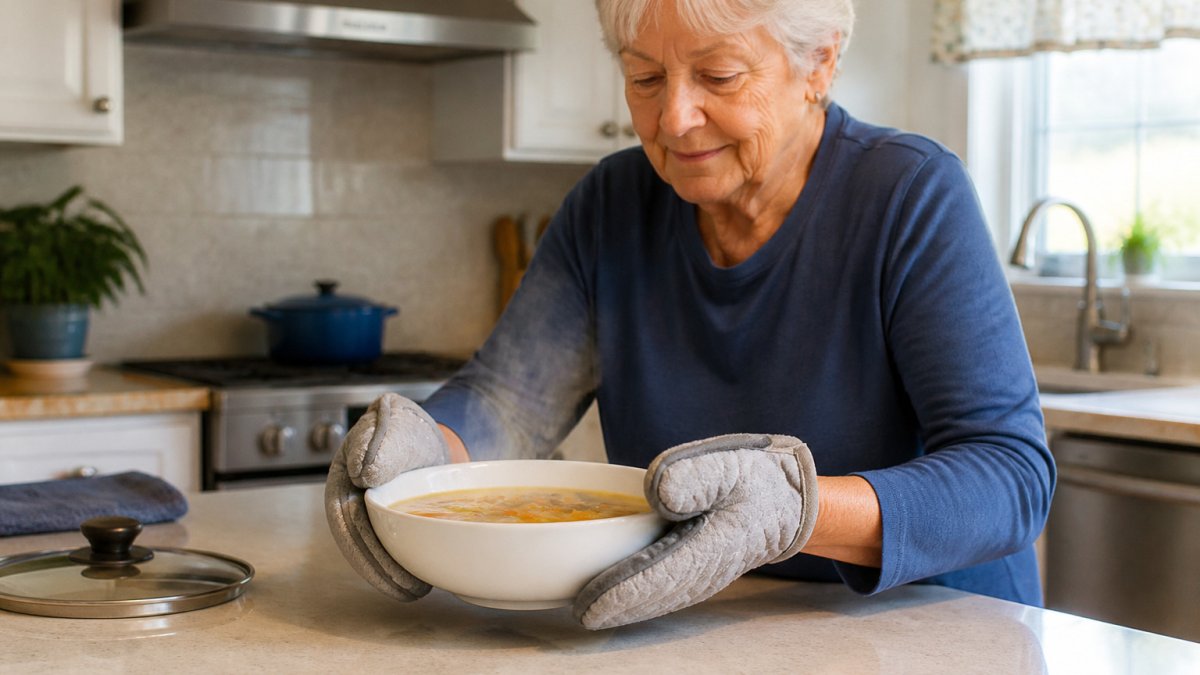
Hot bowls are a common hazard, and they are hard to handle when your hands are sensitive or your grip is weak. See whether bowl cozies protect surfaces from heat marks before you decide. A microwavable bowl cozy gives you a safer, more comfortable hold. Compare bowl cozies with oven mitts for handling hot bowls. Cool Hand Nukes makes handmade 100% cotton bowl cozies in Nova Scotia, designed to fit a standard bowl with a diameter suitable for microwave use. Each one is machine washable, and you can choose from several designs, including the 100% Cotton Microwavable Bowl Cozy - SouperBowl, which is made for soup, and the 100% Cotton Microwavable Bowl Cozy - Good Folk-flora, a bright floral option.


5. Put Frequently Used Items Within Easy Reach
Reaching overhead or bending low repeatedly strains the shoulders, wrists, and hips. Store everyday items such as plates, bowls, and spices between waist and shoulder height. Keep heavier items on lower shelves and near the spot where you use them.
A simple reorganization can save many small trips and reaches over the course of a day. Start with the items you touch most, then work outward.
6. Pace Your Cooking and Sit When You Can
Long periods of standing can increase joint discomfort. Break cooking into smaller tasks with rest breaks in between. A stool or adjustable-height chair at the counter lets you prep vegetables or stir a pot without standing the whole time.
Plan your meal so that tasks requiring the most effort happen when you feel your best. Many people find that a slower, paced approach leads to less fatigue and fewer flare-ups.
7. Simplify Prep With Cut-Free and Low-Effort Methods
Chopping and peeling can be painful, so look for shortcuts. Pre-cut vegetables, frozen ingredients, and rotisserie chicken can save your hands a great deal of effort.
Small appliances such as a food processor or mixer can handle heavy chopping and mixing, reducing the repetitive motion that aggravates joints. Read more kitchen safety habits for seniors on the same topic.
Start With One Change This Week
You don't need to make all seven changes at once. Pick the one that addresses your biggest daily frustration, whether that is jars, hot bowls, or heavy pots, and try it for a week. Small, steady adjustments add up to a kitchen that works with your body instead of against it.
If you are dealing with pain or joint changes, speak with your doctor or an occupational therapist for advice on 7 ways to make kitchen tasks easier with arthritis tailored to your condition. And if you want a simple place to start, a microwavable bowl cozy from Cool Hand Nukes is an affordable way to protect your hands from heat for $20.00.

Frequently Asked Questions
What kitchen tools are helpful for people with arthritis?
Tools with large, padded or lever-style handles reduce the grip force needed for everyday tasks. Look for rocker knives, peelers with wide handles, and tongs with easy-release grips. Choose tools by the task they handle, such as jar openers for lids and heat-protective bowl cozies for hot dishes. Try a tool in the store or at home first, since comfort varies with joint pain and stiffness. Start with the two tasks that cause you the most difficulty.
How can I open jars more easily with arthritis?
A jar opener that clamps onto the lid lets you turn with your whole forearm rather than squeezing with your fingers. Rubber gripping mats or silicone pads can also help when used with a firm, steady surface underneath. Run the jar lid under warm water for a few seconds to loosen the seal before you start. If a lid still resists, ask someone to open it or choose packaging with pull tabs. Keep a jar opener in an easy-to-reach drawer so you use it every time.
Are there adaptive kitchen tools for arthritis that cost little or nothing?
Many useful changes require no purchase. Place a damp towel under cutting boards so they stay put, store often-used items at waist height, and use a dish-drying rack instead of wringing towels. Rolling a cloth around a thin utensil handle adds thickness and reduces grip effort. Bowl cozies from Cool Hand Nukes, priced at $20.00 each, protect your hands from heat when moving hot dishes from the microwave. Combine low-cost habits with one purchased tool that solves your biggest problem.
