
What are the best kitchen tools for hand tremors?
Last Updated: October 25, 2026
Quick Summary
Kitchen tools for hand tremors include weighted utensils, built-up handles, rocker knives, universal cuffs, and electronic self-stabilizing devices designed to reduce spillage and improve control. These adaptive tools work by adding weight for stability, enlarging grips to distribute pressure, or using mechanical and electronic mechanisms to counteract involuntary movement. The right combination can restore independence and confidence in meal preparation and eating.
- Weighted utensils typically weigh approximately one-half pound and help stabilize tremors during eating by adding inertia to counteract rapid hand movements.
- Electronic self-stabilizing utensils range from $300-$500 CAD and use sensors and motors to detect and offset tremor patterns in real time.
- Rocker knives with curved blades use rocking motions instead of chopping, making them easier to control for people with tremor.
- Heat-resistant tongs extend reach to provide ample distance from steam and splashing liquid during stovetop cooking.
- Start with essential tools under $100 CAD like weighted utensils, built-up handles, and heat protection before investing in expensive electronic options.
Table of Contents
- Understanding Hand Tremors and Kitchen Safety
- Weighted Utensils for Tremors: How Added Weight Helps Stability
- Self-Stabilizing Utensils for Tremors: Electronic and Mechanical Options
- Adaptive Kitchen Tools for Hand Tremors: Grips, Handles, and Cutting Solutions
- Safe Cooking Tips for Hand Tremors: Protecting Your Hands and Surfaces
- Choosing and Maintaining Your Kitchen Tools for Hand Tremors
- Selecting the Right Tools for Your Needs and Budget
- Frequently Asked Questions
Understanding Hand Tremors and Kitchen Safety
Hand tremors can make everyday kitchen tasks feel risky and exhausting. Whether you're managing Parkinson's disease, essential tremor, or another condition affecting hand control, preparing meals shouldn't require white-knuckle concentration or constant worry about dropping dishes and utensils.
The good news: adaptive kitchen tools for hand tremors have evolved significantly. These aren't just novelty items; they're engineered solutions designed to restore independence and confidence in the kitchen. The right tools can transform cooking from a source of anxiety into something manageable and even enjoyable again.
At Cool Hand Nukes, we understand how hand tremors complicate daily routines. While our handmade microwaveable bowl cozies address one critical safety challenge (protecting hands from hot dishes), the broader ecosystem of adaptive kitchen tools offers multiple strategies to stabilize your grip, reduce spills, and keep you safe while cooking. This guide covers kitchen tools for hand tremors, from weighted utensils to specialized cutting devices, and shows you how to choose the right combination for your specific needs.
Weighted Utensils for Tremors: How Added Weight Helps Stability
Weighted utensils work by a straightforward principle: added mass dampens involuntary movement. When tremor causes rapid, uncontrolled oscillations in your hand, extra weight acts as a counterbalance, reducing the amplitude of those movements and making your hand steadier.
According to the Michael J. Fox Foundation guidance on assistive devices, weighted utensils typically weigh approximately one-half pound and are specifically designed to help counteract and stabilize tremors during eating. This modest weight is enough to make a measurable difference without causing fatigue or requiring excessive grip strength.
The physics behind this is simple but effective. A tremor causes your hand to shake at a specific frequency, often 4-12 cycles per second depending on the condition. A heavier utensil has more inertia, which means it resists rapid changes in direction. Your hand still trembles, but the utensil's weight prevents those trembles from translating into spilled soup or scattered peas across your plate.
Weighted utensils come in several configurations:
- Weighted spoons and forks with standard bowl or tine designs but denser metal construction
- Weighted handles that slide onto your existing utensils if you prefer to use your own silverware
- Combination sets pairing weighted utensils with built-up handles for enhanced grip
The tradeoff is simple: heavier utensils require more arm strength to lift repeatedly during a meal. If you have limited upper-body strength or fatigue easily, a half-pound utensil might feel tiring after 10-15 minutes of eating. Test before committing to a full set. Many occupational therapists recommend starting with one weighted spoon to assess whether the benefit outweighs the fatigue factor.
Self-Stabilizing Utensils for Tremors: Electronic and Mechanical Options
Beyond passive weight, some utensils use active stabilization technology to counteract tremor in real time. The most researched example is a system which uses a computerized, self-stabilizing handle with attachments including a spoon and fork.
According to the Canadian Agency for Drugs and Technologies in Health review of Liftware, the device is specifically intended to compensate for hand tremor by detecting movement and adjusting the utensil's angle to offset involuntary motion.
How it works: sensors in the handle detect tremor patterns, and a small motor rapidly adjusts the utensil head to counteract those movements. The result feels almost magical; your hand shakes, but the spoon or fork stays level, delivering food to your mouth without wavering.
The catch is cost and complexity. Electronic self-stabilizing utensils range from $300-$500 CAD, require charging, and need occasional maintenance. They're also heavier than standard utensils, which some users find tiring.
Mechanical alternatives exist too. Some rocker spoons and angled utensils use clever design rather than electronics to reduce tremor impact.
A 2024 review in Tremor and Other Hyperkinetic Movements examined peripheral devices and mechanical strategies to reduce tremor, including vibration therapy, limb cooling, and adaptive utensils.
Adaptive Kitchen Tools for Hand Tremors: Grips, Handles, and Cutting Solutions
Beyond eating utensils, the broader category of adaptive kitchen tools addresses food preparation, arguably the more challenging part of cooking when tremor is involved.
Built-up and wide-grip handles are the foundation of tremor-friendly food prep. A standard knife handle requires precise finger positioning and significant grip strength. A built-up handle, essentially a thicker, wider grip, distributes pressure across your whole hand instead of concentrating it in your fingers. This reduces fatigue and improves control.
Universal cuffs and wrist supports offer another layer of stability. A universal cuff wraps around your wrist and holds a utensil or tool in a fixed position, eliminating the need for fine motor control.
For cutting, adaptive knives designed with rocker blades or curved edges work differently than traditional chef's knives. Instead of the up-and-down chopping motion (which tremor amplifies), a rocker knife uses a rocking motion that's often easier to control. The curved blade does the work; your hand mainly provides the rocking motion.
According to Epicurious's guide to cooking tools for Parkinson's, other essential kitchen adaptations include extra-long silicone oven mitts for heat protection, extra-long heat-resistant tongs for handling pots and pans safely, metal mesh cutting gloves to prevent knife injuries, hand-pressure choppers for safer food prep, and claw grabbers for retrieving items without bending or reaching.
The key principle across all these tools: reduce the precision required. Tremor makes fine motor tasks nearly impossible, but gross motor tasks, large movements, rocking motions, and gripping with your whole hand remain manageable.
| Tool Type | Best For | Key Benefit | Cost Range |
|---|---|---|---|
| Weighted utensils | Eating with mild tremor | Passive stabilization | $15-$40 CAD |
| Built-up handles | Food prep and eating | Easier grip and control | $10-$30 CAD |
| Rocker knives | Chopping and cutting | Rocking motion easier than chopping | $20-$50 CAD |
| Universal cuffs | Stirring, whisking, holding | Eliminates fine motor demands | $15-$35 CAD |
| Electronic utensils | Eating with severe tremor | Active stabilization | $300-$500 CAD |
| Heat-resistant tongs | Safe cookware handling | Longer reach, better grip | $12-$25 CAD |
Safe Cooking Tips for Hand Tremors: Protecting Your Hands and Surfaces
Tremor safety in the kitchen extends beyond eating utensils. Hot cookware, sharp blades, and unpredictable hand movements create a hazard zone that requires deliberate strategies.
100% Cotton Microwavable Bowl Cozy - Heavy Duty →
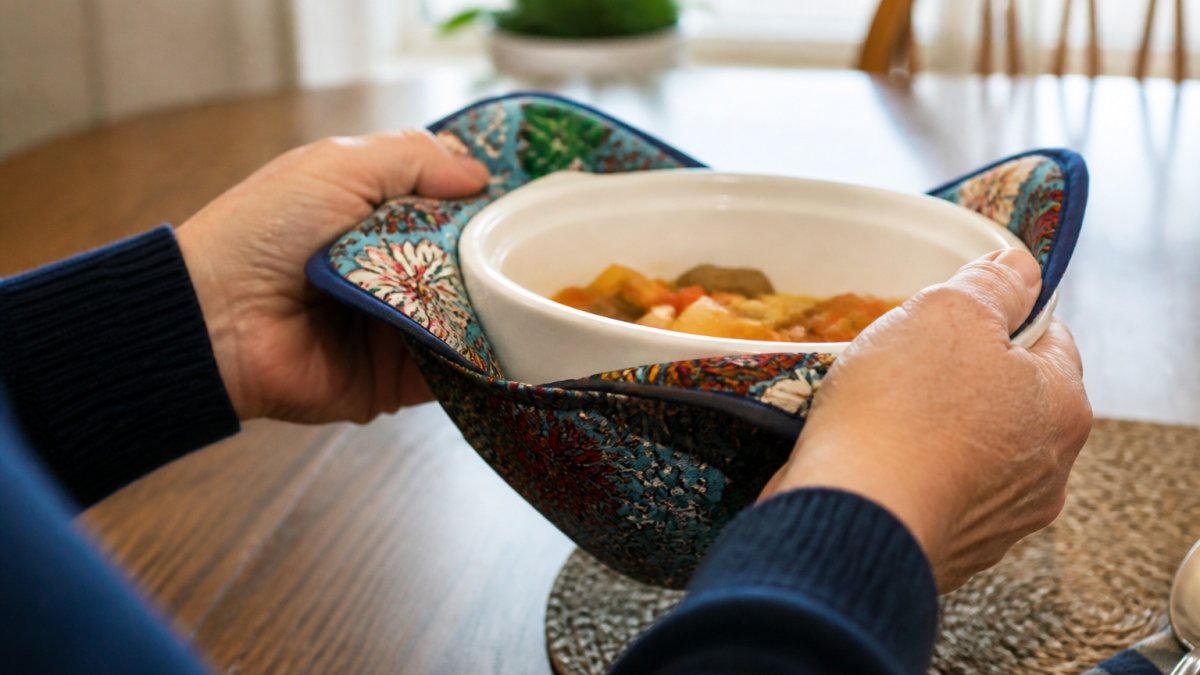
The most common injury risk is thermal burns from hot dishes and cookware. A microwave bowl fresh from heating can reach 65-75°C on the surface, hot enough to cause a serious burn if your tremoring hand loses grip or misjudges the bowl's position. This is where protective solutions matter most.
Watch out: tremor can cause you to misjudge the weight and position of hot dishes. Learn about alternatives to using towels for hot dishes to handle hot items safely.
For stovetop cooking, long-handled tools are non-negotiable. Standard tongs give you about 12 inches of reach; heat-resistant tongs extend that to provide ample distance from steam and splashing liquid. Explore alternatives to bulky oven mitts for seniors to find hand protection solutions that work better with tremor management.
For cutting, the safest approach is often to avoid it. Pre-cut vegetables, canned goods, and rotisserie chicken reduce your knife exposure significantly.
Choosing and Maintaining Your Kitchen Tools for Hand Tremors
Selecting the right tools means understanding your specific tremor pattern and daily cooking habits. Not every tool works for every person.
Start by assessing tremor severity. Mild tremor (slight shakiness but good overall control) often responds well to weighted utensils and built-up handles. Moderate tremor (noticeable shaking that affects precision tasks) benefits from mechanical adaptations like rocker knives and universal cuffs.
Next, identify your pain points. Are you struggling most with eating, food prep, or handling hot dishes? Your answer determines which tools to prioritize.
Trial before buying. Many occupational therapists can lend demonstration tools, and some suppliers offer trial periods. Spending $20-$30 on a weighted spoon to discover it makes your arm tired is far better than committing $400 to an electronic utensil that doesn't fit your needs.
Maintenance is straightforward for most adaptive tools. Hand-wash weighted utensils and built-up handles to avoid dishwasher damage. Most are stainless steel or food-safe plastic, so drying immediately prevents water spots. Electronic utensils require careful cleaning (usually hand-wash only) and regular charging.
Replace tools when they show wear. A built-up handle that's cracking or peeling can harbor bacteria. A weighted utensil with a loose attachment point becomes unreliable. These aren't expensive enough to justify keeping damaged versions.
Selecting the Right Tools for Your Needs and Budget
Budget shapes your choices significantly. A complete tremor-friendly kitchen setup could cost $500-$1,000 CAD if you buy electronic utensils, multiple adaptive tools, and protective gear. But you don't need everything at once.
Start with these essentials under $100 CAD: one or two weighted utensils ($20-$40), a set of built-up handles or adaptive utensils ($30-$50), and a heat-protective solution like a bowl cozy. This foundation addresses eating and basic food prep.
Add mid-range tools ($100-$300) as needed: a rocker knife ($30-$50), heat-resistant tongs and oven mitts ($30-$50), a universal cuff ($20-$30), and perhaps a food chopper or cutting glove ($20-$40). These expand your food prep capability significantly.
Consider electronic options ($300-$500) only if tremor is severe and other tools haven't worked. The investment is substantial, but for someone struggling with independence at mealtimes, it can be life-changing.
For heat protection specifically, Cool Hand Nukes offers handmade microwaveable bowl cozies at $20.00 each.
Affordability and accessibility matter. If cost is a barrier, check whether your provincial health ministry or occupational therapy program offers subsidies for adaptive kitchen equipment.
Managing hand tremors in the kitchen is challenging, but you don't have to choose between independence and safety.
Frequently Asked Questions
Do weighted utensils really help with hand tremors?
Yes. Weighted utensils, which typically weigh approximately one-half pound, are designed to help counteract and stabilize tremors by adding mass that reduces the relative effect of involuntary movement. The added weight gives your hand more control when eating or preparing food. This works best for mild to moderate tremors; severity and individual response vary, so trying before committing is wise.
What's the difference between self-stabilizing utensils and weighted utensils for tremors?
Self-stabilizing utensils use electronic or mechanical systems to actively compensate for movement, while weighted utensils rely on added mass for passive stabilization. Electronic utensils like computerized self-stabilizing spoons adjust in real time to your hand's motion. Weighted options are simpler, more affordable, and work well for many people. Self-stabilizing utensils offer the highest level of compensation but cost more.
Are bowl cozies safe to use in the microwave?
Yes, when made from microwave-safe materials. High-quality bowl cozies crafted from 100% cotton with specialized insulation are designed to protect your hands from hot bowls without melting or catching fire. They are machine washable for easy care. Always check the manufacturer's instructions and ensure the cozy fits your bowl snugly to prevent shifting.
How can I make chopping and pouring safer with hand tremors?
Use adaptive kitchen tools designed for tremor control: rocker knives with curved blades that rock rather than slice, reducing the need for precise hand control; cut-resistant gloves to protect your hands during food prep; and universal cuffs that secure utensils to your wrist for added stability. For pouring, choose pitchers with wide handles and non-slip grips. Practice on softer foods first to build confidence.
What should I look for when choosing kitchen tools for hand tremors?
Prioritize grip quality: wide, non-slip handles reduce strain and improve control. Test weight and balance before buying if possible; tools that are too heavy or poorly balanced can increase fatigue. Look for adaptive equipment recommended by occupational therapists. Consider your specific tasks (eating, chopping, pouring) and tremor severity. Handmade, high-quality options often provide better durability and comfort than mass-produced alternatives.
