
Alternatives to Bulky Oven Mitts for Seniors
Table of Contents
- Why Bulky Oven Mitts Don't Work for Everyone
- Pot Holders for Seniors: A Simpler Grip Alternative
- Easy-Grip Oven Gloves: Design Features That Matter
- Oven Mitts for Limited Dexterity: What to Look For
- Safe Ways to Handle Hot Dishes Without Traditional Mitts
- Comparison: Heat Protection, Grip, and Accessibility
- Frequently Asked Questions
Last Updated: October 19, 2026
Why Bulky Oven Mitts Don't Work for Everyone
Oven mitts for seniors differ from traditional designs that were created for grabbing hot baking sheets straight from the oven. For many seniors, they create more problems than they solve: thick padding reduces hand sensitivity, makes gripping bowls or mugs harder, and is cumbersome to put on and take off, especially with arthritis or hand tremors.
The real issue isn't heat protection, it's that bulky oven mitts sacrifice dexterity and control. When you can't feel what you're holding, accidents happen. A bowl slips. A dish tips. That's when injury occurs.
This guide explores practical alternatives to bulky oven mitts for seniors that prioritize grip, ease of use, and genuine safety.
Pot Holders for Seniors: A Simpler Grip Alternative
Pot holders are the lightest step down from a bulky mitt, and for many seniors they solve two problems at once: no sliding your hand into a tight opening, and you can grab the pad one-handed from a counter or hook. That matters if arthritis, tremor, or reduced grip strength makes donning a mitt a task in itself.
A pot holder gives you direct contact with the item you're holding while still providing a heat barrier. The trade-off is coverage. Pot holders protect your palm and fingers but leave your wrist and forearm exposed. For a bowl fresh from the microwave, that's usually fine.
What to look for when hand strength is limited
- A grab-friendly shape. Square or rectangular pads with a stitched pocket let you slip your hand in without pinching. Avoid pads that are too stiff to fold around a bowl.
- A non-slip surface on both sides. Smooth cotton can slide against a glass bowl or a metal pan. A textured or silicone-dotted surface helps you keep hold even when your grip is weak or your hands are slightly damp.
- Reinforced edges and quilting. Look for multiple layers of insulation and tight stitching at the edges, which is where heat and wear concentrate.
- A size you can manage. An oversized pad can be awkward for small hands; a pad that's too small leaves fingers exposed. Test the fit by folding it around a mug at room temperature.
- A hanging loop. A loop lets you store the pad within reach rather than at the back of a drawer, which reduces reaching and bending.
The safety trade-offs, stated plainly
Pot holders are not a substitute for a mitt on every task.
A practical pattern many seniors adopt is to keep two pot holders within easy reach: one for each hand. Using two pads distributes the load, improves control on heavy dishes, and protects both wrists better than a single pad.
Pot holders are easy to store and maintain: most are machine washable, dry quickly, and take up minimal drawer space. Replace any pad with scorched spots, thinning insulation, or a loose edge, since those are where heat protection fails first.
Easy-Grip Oven Gloves: Design Features That Matter
Easy-grip oven gloves sit between traditional mitts and pot holders. They're designed specifically to address the grip problem that makes standard mitts dangerous for people with reduced hand strength or dexterity challenges.
The best designs feature:
- Textured surfaces that grip even when your hands are slightly damp
- Fitted fingers that let you feel what you're holding
- Wrist support without excessive bulk
- Quick-release closures so you can put them on and take them off with one hand
A well-designed glove lets your fingers move independently rather than being locked together in a mitt. When you can bend your fingers and adjust your grip, you have control, and control prevents accidents.
Silicone Gloves vs. Traditional Fabric
Silicone gloves offer superior grip but come with trade-offs.
The downside: silicone gloves can feel stiff for extended wear, are harder to clean thoroughly, and can retain odors.
Fabric gloves, particularly cotton blends with specialized insulation, offer better comfort for longer wear. They're easier to put on, machine washable, and feel more natural; a textured cotton blend can match silicone grip for most kitchen tasks.
For seniors, the choice often comes down to what you're handling most often. Microwave bowls? Fabric works fine. Heavy roasting pans? Silicone might be worth the extra effort.
Oven Mitts for Limited Dexterity: What to Look For
When shopping for oven mitts for limited dexterity, the goal is not maximum thickness. It's a mitt you can put on, grip with, and take off independently, even when your hands are stiff or painful. Focus on four features: one-handed usability, textured grip, minimal bulk, and a cuff that stays put without squeezing.
One-handed usability
A mitt that requires two hands to don is impractical for someone with arthritis or hand tremors. Look for wide openings, a stiffened cuff that holds its shape, and an elastic or adjustable closure you can tighten one-handed. A pull loop at the cuff helps: hold the loop with one hand and push the other hand in. Test this at room temperature before relying on it with a hot pan.
Textured grip over thickness
Textured grip matters more than thickness. A thinner mitt with an aggressive grip pattern often outperforms a thick, smooth one because your fingers can feel what they're touching, and that feedback prevents accidents. Look for silicone dots, ribbed palms, or a textured synthetic palm, and avoid mitts so padded you can't close your hand around a handle.
Minimal bulk, adequate protection
Minimal bulk doesn't mean zero protection. A well-designed mitt protects adequately without the hand strength a traditional quilted mitt demands. Check the manufacturer's heat-resistance rating and contact-time guidance rather than assuming thicker is safer; heat resistance is not indefinite.
A cuff that stays put
A long cuff protects the wrist and forearm, but a tight one is hard to pull on and can restrict circulation. Look for a cuff long enough to cover the wrist but loose enough to slide over a sleeve, with a closure that keeps it from flopping into the oven element.
A simple assessment before you buy
Use this checklist at the store or before ordering:
- Can you put the mitt on and take it off using only one hand?
- Can you pick up a room-temperature bowl or mug without the mitt slipping?
- Can you feel the shape of the object through the mitt?
- Does the cuff stay up without pinching?
- Can you wash it according to the care label?
If you struggle with grip at room temperature, you'll struggle more when the item is hot and your hands are slightly damp. Many seniors find that having multiple lightweight options, one for microwave use and one for stovetop, works better than trying to find a single mitt that does everything.
When to get professional input
If hand function or sensation is impaired, a mitt alone may not be enough. An occupational therapist can assess grip, reach, and sensation and recommend adaptive tools, and a caregiver can set up the kitchen so protection is within reach before cooking starts. If you have neuropathy or reduced sensation, treat any hot item as hotter than it feels and use more protection, not less.
100% Cotton Microwavable Bowl Cozy - Heavy Duty →
Safe Ways to Handle Hot Dishes Without Traditional Mitts
The safest approach depends on what you're handling and how hot it is. A microwave-heated bowl requires different protection than a pan that's been on the stove for ten minutes.
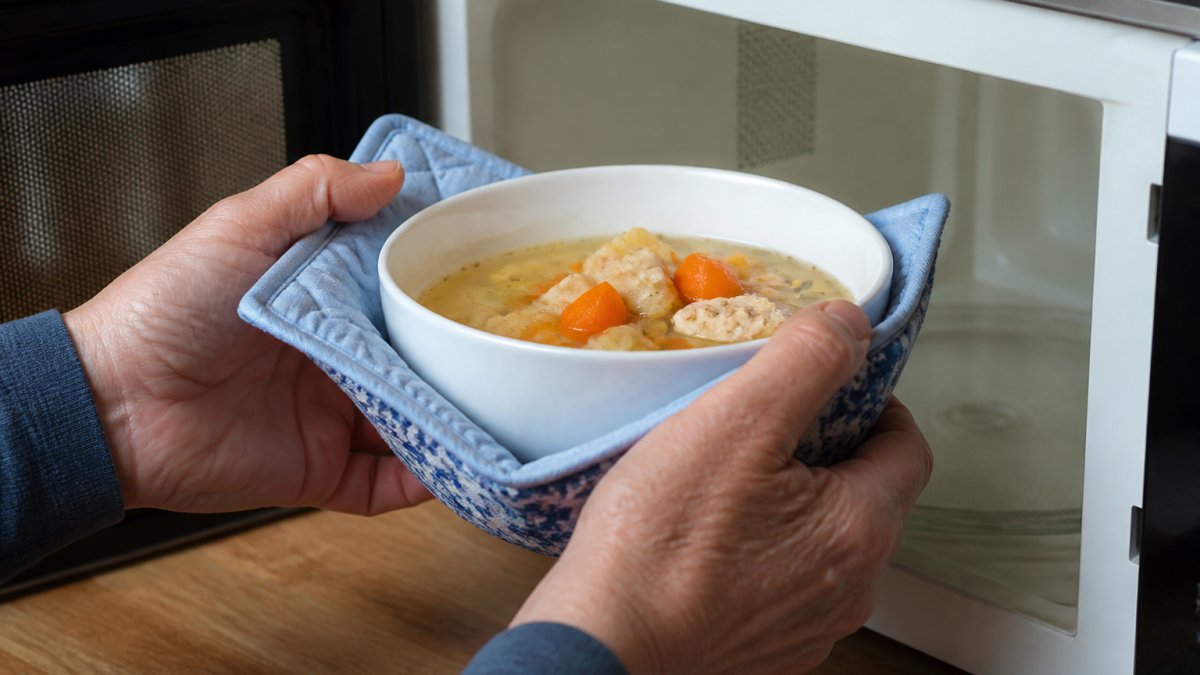
For microwave bowls, a simple fabric cozy or pot holder is often sufficient. The risk isn't extreme heat, it's the shock of unexpected warmth and the difficulty gripping a smooth, rounded surface.
For stovetop items, you need more protection, and easy-grip gloves shine here: forearm coverage without the bulk that makes traditional mitts dangerous.
A practical safety rule: if you can't comfortably grip the item with your glove on, wait longer for it to cool. Speed isn't worth a dropped dish or a burn.
Microwaveable Bowl Cozies: A Specialized Solution
A microwaveable bowl cozy is designed specifically for the microwave-bowl problem.

The best cozies use 100% cotton with specialized insulation.
A quality cozy fits snugly over standard bowl sizes (typically 10-20 cm in diameter) and machine washes easily.
Cool Hand Nukes makes microwaveable bowl cozies in various designs, each handmade in Nova Scotia from 100% cotton with specialized insulation. They're priced at $20.00 each and ship free across the country.
The real advantage of a dedicated cozy is simplicity: no adapting a general-purpose glove to a specific task. It does one thing extremely well, keeping your hands safe when handling a hot microwave bowl.
| Alternative | Best For | Heat Protection | Grip Quality | Ease of Use |
|---|---|---|---|---|
| Pot Holders | Small items, brief contact | Moderate | Good | Excellent |
| Easy-Grip Gloves | Mixed tasks, extended wear | Good | Excellent | Very Good |
| Silicone Gloves | Wet items, maximum grip | Good | Excellent | Fair |
| Fabric Gloves | Comfort, daily use | Good | Excellent | Excellent |
| Microwaveable Bowl Cozies | Microwave bowls specifically | Excellent | Very Good | Excellent |
Comparison: Heat Protection, Grip, and Accessibility
Each alternative balances three competing needs: heat protection, a secure grip, and accessibility for someone with limited hand strength or dexterity.
Traditional bulky mitts prioritize heat protection at the expense of everything else.
Pot holders sacrifice some heat protection to gain grip and accessibility.
Easy-grip gloves balance all three needs: adequate heat protection, superior grip, and one-handed usability.
Silicone gloves excel at grip but can be uncomfortable and difficult to put on.
Microwaveable bowl cozies solve a specific problem exceptionally well. If microwave bowls are your primary concern, a dedicated cozy outperforms any general-purpose glove, delivering maximum protection with minimum effort.

Handling hot dishes safely becomes easier when you stop forcing yourself into tools designed for someone else's hands.
We recommend starting with a microwaveable bowl cozy if microwave meals are part of your routine. The variety of designs means you get genuine heat protection that actually fits your kitchen and your life. Click Here to Learn More!
Frequently Asked Questions
What can seniors use instead of bulky oven mitts?
Seniors have several effective alternatives to traditional oven mitts. Pot holders offer a simpler, easier-to-grip option for handling hot cookware. Easy-grip oven gloves with textured surfaces provide better control for those with reduced hand strength. Silicone gloves offer superior grip on wet or slippery pans. For microwaved bowls, specialized bowl cozies like those from Cool Hand Nukes provide targeted heat protection without the bulk, using 100% cotton with insulation designed specifically for this purpose.
Are pot holders easier to grip than oven mitts?
Yes, pot holders are generally easier to grip than traditional mitts. Because they're smaller and don't encase your entire hand, they require less dexterity to hold and position. Pot holders work well for seniors with limited hand strength or tremors, as they allow you to maintain better control of cookware. However, they offer less forearm protection than mitts, so they're best suited for quick transfers rather than prolonged contact with very hot items.
Can I safely use a kitchen towel instead of oven mitts?
Kitchen towels are not a reliable substitute for heat-protective gear. Towels absorb moisture, which conducts heat directly to your skin, increasing burn risk. They also slip easily on smooth cookware, creating fumbling hazards. For seniors with reduced grip strength or hand tremors, this instability is especially dangerous. Purpose-designed alternatives like pot holders, silicone gloves, or bowl cozies provide tested heat resistance and grip features that kitchen towels cannot match.
What should seniors look for in an oven mitt alternative?
The best alternatives for seniors combine three key features: reliable heat resistance rated for your typical cooking temperatures, a textured or grippy surface that works even with reduced hand strength, and ease of putting on and taking off without fumbling. Consider whether you need wrist coverage for forearm protection, and check that the fit accommodates any hand mobility limitations. For microwave use specifically, insulated bowl cozies designed for this purpose offer targeted protection without bulk.
How do microwaveable bowl cozies provide better safety for seniors?
Microwaveable bowl cozies are specifically designed for the unique challenge of handling hot microwave bowls. Unlike traditional oven mitts, they're lightweight, easy to put on, and don't require gripping strength to stay in place. The cozy wraps around the bowl rather than your hand, reducing fumbling risk. Made from 100% cotton with specialized insulation, they protect hands from heat while remaining washable and durable. For seniors with tremors or limited dexterity, this simplified approach significantly reduces accident risk during daily microwave use.