
10 Kitchen Safety Tips Every Senior Should Know
Quick Summary
The best kitchen safety tips for seniors focus on clearing floors and walkways, improving task lighting, keeping everyday items within easy reach, wearing supportive non-slip footwear, and protecting hands with dry, insulated tools. Never leave cooking unattended, and handle food with a thermometer and separate boards to prevent illness.
- Most kitchen falls start with clutter, loose cords or slipping rugs.
- Use dry oven mitts or insulated cozies, since a damp towel can burn within seconds.
- Never pour water on a grease fire; smother it with a metal lid instead.
- Test smoke alarms monthly and replace batteries at least once a year.
- Cook and reheat food using a thermometer, and refrigerate perishables within two hours.
Table of Contents
- Why Kitchen Safety Matters More as We Age
- 1. Clear Floors and Walkways of Clutter and Trip Hazards
- 2. Improve Lighting Over Work Areas
- 3. Store Everyday Items Within Easy Reach
- 4. Use Non-Slip Mats and Supportive Footwear
- 5. Protect Your Hands and Skin From Hot Dishes and Cookware
- 6. Never Leave Cooking Unattended and Use Reminders
- 7. Handle Food Safely to Prevent Illness
- Frequently Asked Questions
Keeping your hands safe from a hot bowl is one of the simplest kitchen habits to build, and it matters more as we age. At Cool Hand Nukes, we make handmade microwavable bowl cozies in Nova Scotia, so we spend a lot of time thinking about how heat, grip and everyday kitchen layout affect safety. This guide covers ten practical steps that help older adults and caregivers cut down on falls, burns and food-safety problems at home.
Quick Picks:
- Clear the floor first: most kitchen falls start with clutter or loose mats.
- Protect your hands: use insulated, stable tools for hot dishes.
- Stay with the stove: most cooking fires start when no one is watching.
Why Kitchen Safety Matters More as We Age
Kitchen safety is the set of habits and home changes that prevent falls, burns, fires and foodborne illness while cooking. As balance, vision, grip strength and reaction time change, small hazards that were once easy to manage become real risks. A cluttered floor, a dim counter or a pot handle over the edge of the stove can all lead to injury.
The good news is that most fixes are inexpensive and quick. The sections below walk through them in order, starting with the floor you stand on.
1. Clear Floors and Walkways of Clutter and Trip Hazards
Start with the floor. Walk the kitchen once and look for anything that could catch a foot: loose cords, bags, pet bowls, or boxes waiting to be unpacked. Keep walkways clear enough to pass without turning sideways.
Pay attention to rugs as well. A rug that slides or curls at the edges is a common cause of falls. If you do use one, choose a low profile with a non-slip backing, and check the edges every week.
2. Improve Lighting Over Work Areas
Good light lets you see edges, steam, and the level of liquid in a pot. Add task lighting over the stove, sink and counters, since these are the places where most kitchen mistakes happen. Battery-operated LED strips are an easy option when you cannot run new wiring.
Replace any bulbs that flicker or have dimmed, and wipe light covers regularly. Many people are surprised by how much a dirty fixture reduces brightness.
3. Store Everyday Items Within Easy Reach
Keep plates, mugs, cooking oil and the items you use daily between shoulder and waist height. Reaching overhead, bending to a low cupboard or climbing onto a stool are all common sources of falls and strains.
Heavy pots and small appliances belong on lower shelves at waist level, where they are easy to lift with both hands. Keep sharp knives in a block or magnetic strip rather than a drawer you have to dig through.
4. Use Non-Slip Mats and Supportive Footwear
Your feet are your foundation in the kitchen. Wear closed-toe shoes with good tread and firm soles, and avoid socks on hard floors or slippers with thin soles.
A non-slip mat in front of the sink and stove can help, provided it lies flat and is not worn through. Check it regularly for curled corners and replace it when the backing starts to peel.
5. Protect Your Hands and Skin From Hot Dishes and Cookware
Hot bowls, lids and pans cause a surprising number of burns, especially when grip is weaker or hands shake. Use dry, thick oven mitts or pot holders rather than a damp towel, which can carry heat through to the skin.
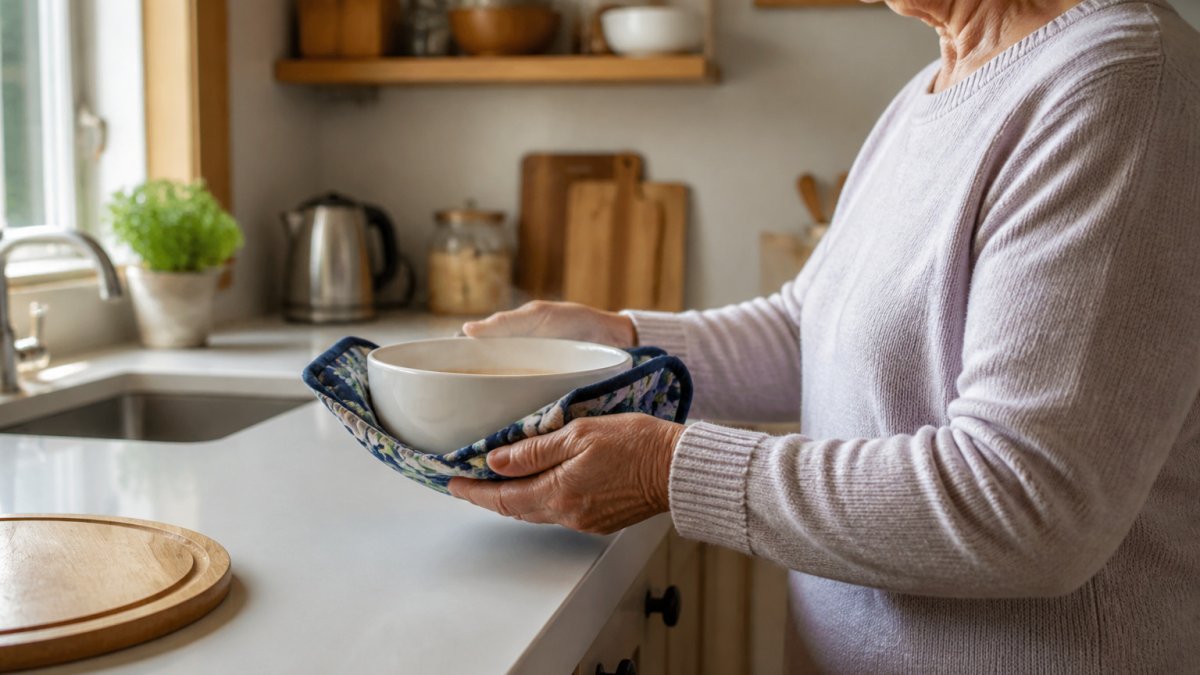
For microwaved food, an insulated bowl cozy gives you a stable, heat-resistant grip. Our cozies are made from 100% cotton with specialized insulation and are machine washable. Cool Hand Nukes makes the Mystic Vibes, Heavy Duty and Playing Koi designs, among others, each sold for $20.00 CAD.
Watch out: a damp towel can transfer heat to your hand within seconds. Keep your protection dry.
Choosing the right hand protection makes a real difference when handling hot dishes, and the article's key points are summarised below.
100% Cotton Microwavable Bowl Cozy - Mystic Vibes →
| Protection | Why it matters | Key note |
|---|---|---|
| Dry oven mitts or pot holders | Thick and dry block heat | Avoid damp towels |
| Damp towel | Carries heat to the skin | Can burn within seconds |
| Insulated bowl cozy | Stable, heat-resistant grip | 100% cotton, machine washable |
| Cool Hand Nukes cozy | Designs sold at a set price | $20.00 CAD each |
6. Never Leave Cooking Unattended and Use Reminders
Most kitchen fires start when a pan is left on the heat, and the risk climbs when memory, hearing, or mobility changes make it easy to step away 'just for a second.' The fix is not willpower, it is a routine that makes leaving the stove harder to forget and safer if you do.
Build a stay-put routine. Turn on the exhaust fan or a task light whenever a burner is on; the sound and light act as a reminder that heat is active. Carry a timer or your phone with you if you must step away, and set it before you turn your back.
Use the right equipment. A common pattern among safety practitioners is to recommend automatic shutoff devices for electric stoves and induction cooktops, which cut power after a set period or when no movement is detected. These are especially useful for people with cognitive changes or hearing loss.
Know what to do in a kitchen fire. Response steps differ by fire type, and getting them wrong makes things worse:
- Grease or pan fire: Turn off the burner if you can do so safely. Smother the flames with a metal lid or a large metal baking sheet. Never pour water on a grease fire, it can cause a violent steam explosion that spreads burning oil. Never carry a burning pan outside; the motion can splash hot oil onto you.
- Oven or microwave fire: Keep the door closed and turn off the appliance. The fire will usually smother from lack of oxygen. Unplug the microwave only if you can reach the cord safely.
- Anything that spreads beyond the pan: Get out, close the door behind you, and call 911 from outside. Do not go back in.
Make smoke alarms work for you. Test smoke alarms monthly and replace batteries at least once a year, or sooner if the alarm chirps. Photoelectric alarms tend to respond faster to smoldering fires, while ionization alarms respond faster to flaming fires; a combination alarm covers both. For older adults with hearing loss, consider an alarm with a visual strobe or a bed-shaker attachment. Never disable an alarm because cooking sets it off, move it farther from the kitchen or use a hush button instead.
Plan for a moment of confusion. Keep a phone or medical alert device on your person, not across the room. If you are interrupted mid-cook, turn off the heat first, then deal with the interruption.
7. Handle Food Safely to Prevent Illness
Food safety matters more for older adults because the immune system weakens with age and stomach acid production can decline, making it easier for pathogens to cause serious illness. The goal is not to memorize a long list of rules but to build a few habits that fit how you actually cook.
Temperature is the control point. Use a food thermometer rather than judging by color or time. Cook poultry to a safe internal temperature, reheat leftovers until steaming hot throughout, and keep hot foods hot (above 60°C / 140°F) and cold foods cold (below 4°C / 40°F).
Separate raw and ready-to-eat foods. Use one cutting board for raw meat, poultry, and seafood and another for produce and cooked foods, or wash the board with hot soapy water between uses. Keep raw meat on the bottom shelf of the fridge so juices cannot drip onto other food.
Adapt for vision, grip, and memory changes. These are the practical adjustments competitors rarely mention:
- Vision: Use high-contrast labels and a magnifier on the fridge and pantry so you can read use-by dates. A talking or large-display thermometer removes the guesswork. Keep a small flashlight or task light near the prep area.
- Grip and strength: Choose easy-grip utensils, jar openers, and lightweight cutting boards with non-slip feet. Pre-cut or frozen produce reduces the amount of knife work and the time food sits out.
- Memory: Keep a simple 'use first' shelf in the fridge and a whiteboard or phone note listing what needs eating. A fridge thermometer with an audible alarm helps catch a door left ajar.
Handle leftovers and reheating with care. Divide large batches into shallow containers so they cool quickly, and reheat leftovers to steaming hot throughout rather than just warming them. Do not thaw food on the counter, thaw in the fridge, in cold water changed every 30 minutes, or in the microwave followed by immediate cooking.
Caregiver involvement helps. If a family member or caregiver helps with shopping or meal prep, agree on a simple system: label dates when food goes into the fridge, check the fridge thermometer weekly, and review the 'use first' shelf together. Shared routines make food safety less dependent on memory and more built into the kitchen itself.
Frequently Asked Questions
What are the top 10 safety rules to follow in the kitchen?
The most important rules are keeping floors clear, lighting work areas well, storing items within easy reach, wearing non-slip footwear, using oven mitts or pot holders for hot cookware, staying in the kitchen while cooking, handling food at safe temperatures, cooking when alert, storing knives safely and keeping a fire extinguisher nearby. Working through these ten tips in order is a practical way to spot and fix the biggest risks in a home kitchen.
How can seniors prevent falls in the kitchen?
Start by removing loose rugs, cords and clutter from walkways, and add non-slip mats at the sink and stove. Make sure frequently used items sit between shoulder and waist height so you avoid reaching, bending or climbing on a stool. Good lighting over counters and the stove also helps you see changes in the floor. Wear closed shoes with good traction rather than socks or slippers.
How can older adults reduce the risk of burns while cooking?
Turn pot handles inward, use oven mitts or silicone pot holders for hot cookware, and lift lids away from your face to avoid steam. Stay in the kitchen when frying, grilling or broiling, and set a timer as a reminder when something is on the stove. Keep a heat-resistant cover on hand so you can lift a hot bowl straight from the microwave without gripping it directly.
What should seniors keep within easy reach in the kitchen?
Keep daily-use items such as plates, mugs, cooking oil, utensils and frequently used pans between shoulder and waist height. Store heavy items like cast iron pans or large containers low enough to lift safely with both hands. Keep a flashlight or battery lighting strip nearby for power outages, and keep a fire extinguisher where you can reach it without climbing.
The steps above add up quickly, and most cost little or nothing. Start with the floor and the reach of your everyday items this week, then move to hot-dish protection and timers. If you want a stable, heat-resistant grip for your microwave bowls, explore the Cool Hand Nukes collection of 100% cotton bowl cozies, each $20.00 CAD with free shipping across Canada.
