
7 Ways to Prevent Microwave Burns
Last Updated: October 26, 2026
Quick Summary
To prevent microwave burns, choose microwave-safe containers, avoid metal and aluminum foil, understand the dangers of superheated liquids, remove hot food carefully by opening the door slowly and stepping back from steam, allow food to stand for one to two minutes after cooking, supervise children, and use protective gear like oven mitts and bowl cozies.
- Never heat water or other liquids for more than two to three minutes at a time in a microwave without stirring.
- Always open the microwave door slowly and count to three before reaching in to let steam escape.
- Allow most foods to stand for at least one to two minutes after the microwave cycle ends.
- Keep all metal objects and containers with metallic trim out of the microwave oven entirely.
- Supervise children using the microwave and teach them that containers can become extremely hot even though they don't generate the heat.
Table of Contents
- 1. Choose Microwave-Safe Dishes and Containers
- 2. Never Use Metal or Aluminum Foil
- 3. Understand Superheated Liquids and Delayed Boiling
- 4. How to Safely Remove Hot Food from a Microwave
- 5. Let Food Stand and Apply Microwave Safety Tips
- 6. Supervise Children and Educate on Microwave Safety
- 7. Use Protective Gear Like Bowl Cozies to Prevent Burns
- Protect Your Hands with a Handmade Bowl Cozy
- Frequently Asked Questions
1. Choose Microwave-Safe Dishes and Containers
The first step to prevent microwave burns is selecting the right containers. Not all dishes are created equal when it comes to microwave use. Some materials heat up dangerously fast, while others remain cool to the touch even after heating hot food inside them.
Microwave-safe containers are specifically designed to withstand microwave radiation without absorbing excessive heat or leaching harmful substances into your food. Look for labels that explicitly state "microwave-safe" on the bottom of dishes. Glass, ceramic, and certain plastics marked as microwave-safe are your best options. These materials reflect microwave energy rather than absorbing it, keeping the container cooler while the food inside heats properly.
Avoid containers with metallic trim, glazes, or decorative elements that can spark. Test unfamiliar dishes by microwaving them empty for one minute. If the container gets hot while the microwave plate stays cool, that container is absorbing too much energy and isn't safe for frequent use. According to research on microwave-related burn injuries, the container itself is often the culprit in hand and arm injuries when people grab overheated dishes without protection.
Knowing which containers are safe eliminates guesswork.
| Container Type | Microwave Safe | Why or Why Not |
|---|---|---|
| Glass | Yes | Doesn't absorb heat; stays cool |
| Ceramic | Yes | Inert material; safe for most uses |
| Microwave-safe plastic | Yes | Engineered to withstand heat |
| Metal or metallic trim | No | Causes sparking and arcing |
| Unglazed ceramic | Sometimes | Test first; can absorb moisture and heat |
2. Never Use Metal or Aluminum Foil
Metal and aluminum foil have no place in a microwave oven. This is one of the most critical microwave safety tips because the consequences are immediate and dangerous. When metal comes into contact with microwave radiation, it reflects the energy instead of absorbing it, causing electrical arcing that can spark and potentially start a fire.
Even small amounts of metal cause problems. A fork left in a dish, a metallic glaze on a plate, or decorative trim on a ceramic bowl can trigger sparking. The arcing heats up the metal rapidly, creating hot spots that can burn your hands if you touch them while removing the dish from the microwave.
Never assume a container is safe just because it looks innocuous. Some vintage dishes and imported ceramics contain metallic paints or glazes that aren't obvious at first glance. When in doubt, skip it. The risk isn't worth the convenience. This rule applies to aluminum foil as well, even though some people mistakenly believe small amounts are acceptable. They are not.
If you do accidentally microwave something with metal, stop the microwave immediately and remove the item. Do not attempt to finish heating the food in that container.
3. Understand Superheated Liquids and Delayed Boiling
One of the most dangerous microwave burn scenarios involves superheated water and other liquids. This is where most guides fall short, and it's critical to understand because the danger isn't always obvious.
Superheated liquids occur when water or other beverages are heated in a microwave without any agitation or boiling. The liquid reaches temperatures well above its normal boiling point without actually boiling. When you remove the container or add something to the liquid, it can suddenly and violently boil, sending scalding liquid onto your hands, arms, and face.
This delayed boiling happens because the microwave heats the liquid evenly throughout, but without the nucleation sites that normally trigger boiling (like bubbles forming on the container's surface), the liquid remains calm on the surface even though it's dangerously hot inside.
To prevent this, never heat water or other liquids for more than two to three minutes at a time in a microwave oven. Stir the liquid halfway through heating. Place a wooden stick or microwave-safe object in the container before heating to provide nucleation sites. If you must heat liquids, use a stovetop instead; it's slower but infinitely safer.
4. How to Safely Remove Hot Food from a Microwave
The moment you open the microwave door, steam escapes rapidly from hot food and containers. This steam is invisible but extremely hot, and it can cause severe burns on your face, hands, and arms if you're not careful. Learning how to safely remove hot food is essential to prevent microwave burns.
Always open the microwave door slowly and step back immediately. Let the steam escape before reaching into the microwave. Count to three after opening the door, giving the initial rush of hot air time to dissipate. This simple pause prevents most steam burns.
When removing a hot container, use both hands and keep it away from your body. Never reach across the container to grab it; approach from the side or back. Wear oven mitts or use a kitchen towel for extra protection, especially if the container feels hot to the touch.
If the container is too hot to hold even with protection, leave it in the microwave for another minute or two. There's no prize for speed. Patient removal prevents burns far more effectively than rushing. This approach to safe handling applies whether you're using a standard microwave oven or removing any heated container from any appliance.
5. Let Food Stand and Apply Microwave Safety Tips
Standing time after microwaving is not just about even heat distribution; it's a critical burn prevention step. When you remove food from the microwave oven, the interior continues heating even as the outside begins to cool. This carryover cooking makes the food hotter than when you first removed it.
Standing Time After Microwaving
Allow most foods to stand for at least one to two minutes after the microwave cycle ends. During this time, the heat distributes evenly throughout the food, and the surface cools slightly. Soups, stews, and beverages need longer standing times, at least two to three minutes, because liquids retain heat longer than solid foods.
100% Cotton Microwavable Bowl Cozy - Kind of a Big Dill →
Standing time also allows steam inside covered containers to cool enough that opening the lid won't result in a sudden burst of scalding vapor. This is one of the most underrated microwave safety tips. Many burns happen not during cooking but immediately after, when people open containers too quickly.
Use the standing time to prepare your plate, gather utensils, or simply step away from the microwave. Your food will be just as hot when you eat it, but significantly safer to handle.
6. Supervise Children and Educate on Microwave Safety
Children are at particular risk for microwave-related burns because they don't always understand the dangers or follow safety guidelines consistently. Supervision is non-negotiable if children use the microwave in your home.
Teach children that the microwave oven heats food, not the container, a common misconception. Explain that containers can become extremely hot even though they don't generate the heat themselves. Show them how to identify microwave-safe containers and why metal is dangerous. Make it a rule that children must ask an adult before using the microwave, or establish a rule that only adults use it.
Keep the microwave at a height where children can see inside without standing on a chair or stool. Unstable positioning increases the risk of spills and burns. Demonstrate proper technique: opening the door slowly, stepping back from steam, using oven mitts, and waiting before touching containers.
According to national estimates of microwave-related burn injuries, some burns could be prevented by redesigning microwaves to make it harder for young children to open the door. Until that happens, adult supervision and clear education are your best defenses.
7. Use Protective Gear Like Bowl Cozies to Prevent Burns
The most direct way to prevent microwave burns is to add a barrier between your hands and hot containers. Protective gear like bowl cozies, oven mitts, and kitchen towels provide essential insulation when handling heated dishes.
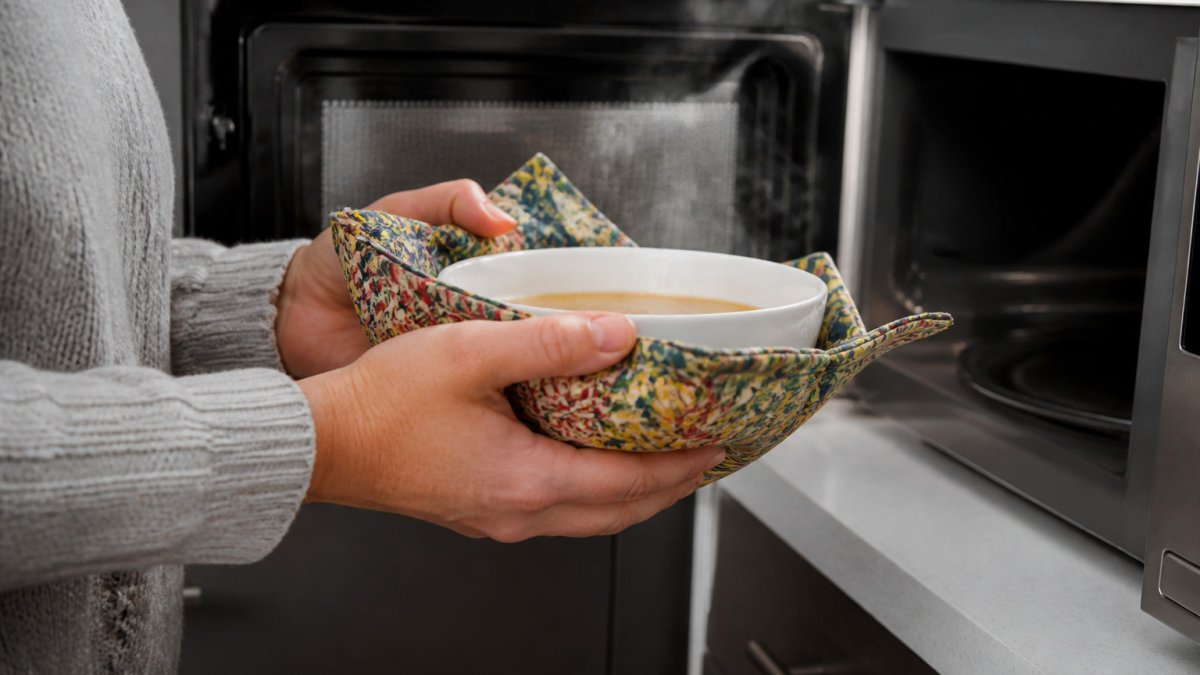
A bowl cozy is designed to fit around bowls. This is especially valuable for people with hand tremors, reduced grip strength, or conditions like arthritis that affect hand mobility and sensitivity.
Cool Hand Nukes bowl cozies are made from 100% cotton with specialized insulation materials. They're machine washable. Options like the 100% Cotton Microwavable Bowl Cozy - SouperBowl are available.

For added safety, pair your bowl cozy with proper technique: use both hands, keep the bowl away from your body, and set it down on a stable surface before opening any lids.
Watch out: not all fabric bowl cozies are microwave-safe. Always verify that a cozy is explicitly labeled as microwave-safe before using it.
Protect Your Hands with a Handmade Bowl Cozy
Preventing microwave burns requires a multi-layered approach: choosing safe containers, understanding heat dangers, handling food carefully, and using protective gear.
Cool Hand Nukes offers handmade microwavable bowl cozies that combine style with function. Made from 100% cotton with specialized insulation, each cozy fits standard bowls and is machine washable for easy care. With designs ranging from the playful 100% Cotton Microwavable Bowl Cozy - Kind of a Big Dill to the elegant 100% Cotton Microwavable Bowl Cozy - Kiss of the Mandevilla, there are different designs to choose from.


Free shipping across the country means your bowl cozy arrives ready to use. Whether you're looking for a bowl cozy for daily meals or a thoughtful housewarming gift, Cool Hand Nukes offers handmade bowl cozies. Learn more about are fabric bowl cozies microwave safe and discover why comfort and hand protection matter when choosing bowl cozies.
Frequently Asked Questions
How can you prevent burns when using a microwave?
Prevent microwave burns by using microwave-safe containers, avoiding metal and foil, letting food stand after cooking, and always opening lids or covers away from your face to avoid steam burns. Supervise children closely. Be especially careful with liquids, which can superheat and boil suddenly when disturbed.
What are the best microwave safety tips for daily cooking?
Follow these microwave safety tips: use only microwave-safe dishes, stir food halfway through cooking to prevent hot spots, avoid overheating liquids, and always open containers slowly and carefully. Never leave the microwave unattended, keep it clean to prevent sparking, and use oven mitts when removing hot bowls. Allow proper standing time for food to cool slightly before eating.
How long should food sit after microwaving?
Most foods benefit from 1-3 minutes of standing time after microwaving. This allows heat to distribute evenly throughout the food. Liquids and dense foods like soups should stand for 2-3 minutes. Standing time also gives the food time to cool slightly. Always use oven mitts when removing dishes during or immediately after the standing period.
Can microwave-safe dishes still get hot and cause burns?
Yes. Microwave-safe dishes can still become very hot because they conduct heat from the food inside. The microwave heats the food, which then heats the container. Even microwave-safe ceramics, glass, and plastics can reach temperatures hot enough to burn skin. Always use oven mitts or kitchen towels when removing dishes, and be especially cautious with soups and beverages that transfer heat quickly to the container.
Why do microwave burns happen from steam and hot spots?
Microwaves heat food unevenly, creating hot spots where temperatures spike. Steam forms when moisture in food or liquids heats rapidly. When you open a microwave cover or container lid, steam escapes suddenly and can cause severe burns to your face, hands, and arms. Superheated liquids can also boil violently when disturbed. Always open containers slowly and tilt lids away from your body.
Microwave safety doesn't require complicated equipment or rigid rules, just awareness and the right tools. A handmade bowl cozy from Cool Hand Nukes keeps your hands protected, your surfaces safe from heat marks, and your mealtime experience comfortable and worry-free.
